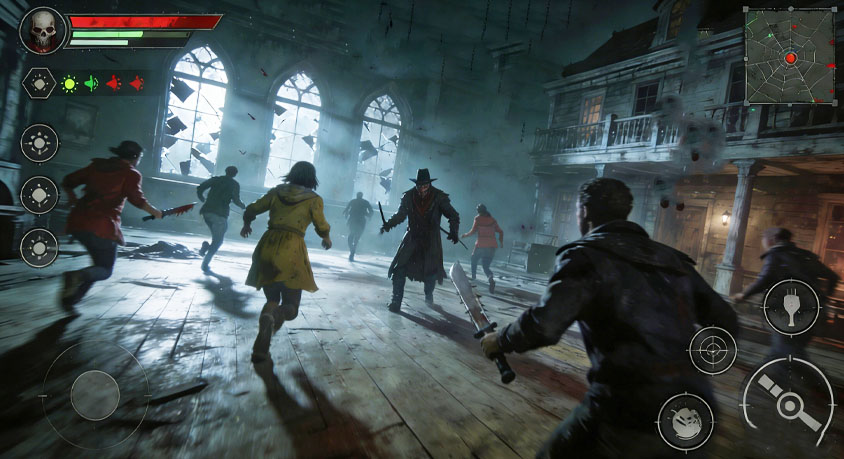
Let’s talk about the most unlikely, bizarrely successful peace summit in modern entertainment history. It doesn’t happen in a boardroom, but in a foggy, eternally twilight forest where the sound of a humming chainsaw can be punctuated by the snikt of adamantium claws. Dead by Daylight started as a simple, scrappy premise: four survivors try to fix generators while one killer hunts them. But over the years, it has undergone a transformation so audacious it would make a Hollywood agent’s head spin. It’s no longer just a game. It has become the world’s foremost, and frankly slightly unhinged, horror icon refugee camp. It’s where intellectual property lawyers go to die, and where Freddy Krueger, Michael Myers, and Stranger Things’ Demogorgon awkwardly share a locker room, waiting for their turn to chase Claudette and Dwight. The question isn't "who have they added?" anymore. It's "who haven't they added, and is it only because the legal paperwork is currently lost in the Entity's fog?"
Think about the sheer cultural whiplash of a single match. You, as a survivor, could be the final girl from Scream, Nea Karlsson (a punk-rock original character), and the guy from Left 4 Dead, all working together to outwit a killer who might be the titular villain from The Ring, or a sententious, pyramid-headed cult leader from Silent Hill. This isn't a crossover event; it's a cultural meltdown. It’s the equivalent of finding out that Dracula, Godzilla, and the Alien all have timeshares in the same cursed cabin. The game's genius is that its core loop—the desperate cat-and-mouse chase—is the universal language that every horror character speaks. A jump scare is a jump scare, whether you're wearing a Shattered Mask or a Ghostface robe. The Entity, the game's nebulous god-like being that traps everyone, is the ultimate narrative hand-wave: a cosmic, all-powerful talent agent who doesn't care about copyright, only about fear.
This is where the real "impossible" victory lies. It's not in any single character addition, though snagging someone like Pinhead from the notoriously rights-averse Clive Barker universe felt like a minor miracle. The true impossibility they've conquered is the logistical and legal nightmare of making these universes coexist. They've had to negotiate with studios, estates, and creators who are famously protective of their legacies. They've had to design powers that feel true to characters as disparate as a fast-zombie (The Nemesis) and a slow, stalking shape (The Xenomorph). They've turned the game into a living museum of horror history, where a new player might learn about the original The Thing because they just got mori'd by a shape-shifting monster they'd never heard of before. It’s horror education via repeated, panicked murder.
But beneath the licensing triumph is a warmer, weirder truth about the community. This game has fostered a shared language that transcends any single franchise. Phrases like "tunneled by a Bubba" or "face-camped by a Ghostface" are understood by millions, regardless of whether they’ve seen The Texas Chain Saw Massacre or Scream. The original characters, once generic placeholders, have become beloved figures in their own right, holding their own alongside cinematic legends. The game argues, persuasively, that the heart of horror isn't in exclusive ownership, but in shared experience—the collective gasp, the shared sigh of relief, the communal groan at a poorly timed dead hard. It’s a party where everyone is invited, as long as they bring something scary to the table.
So, the next "impossible" icon they add isn't really the point. The point is that they’ve built the only arena where such a question even makes sense. Is it a "horror Avengers"? Not quite. The Avengers had a coherent plan. Dead by Daylight is more like the world's most stressful, legally-complex Halloween party, thrown by a god who really likes generators. And we keep RSVPing "yes" because there’s nowhere else on Earth where you can watch Leatherface try to chase down Ash Williams while a little old lady who controls crows (The Artist, an original) helps set a bear trap. It’s beautiful. It’s stupid. It’s a miracle it exists at all.
Disclaimer: Mention of any brand or trademark is for identification only and does not imply partnership or endorsement