Let me tell you about a relationship. Not a romance, not a friendship, but something deeper, more intimate, and infinitely more complicated: the relationship between a driver and their car. If you're American, you understand this on a cellular level. The first car isn't just transportation; it's freedom, identity, a metal shell around your teenage dreams. The beaters we drove in our twenties, with their mysterious noises and optimistic check engine lights, weren't just machines; they were companions. They were unreliable, infuriating, and absolutely, stubbornly beloved. Now imagine that relationship transplanted into a horror-soaked, radiation-blasted version of the Olympic Peninsula, where the car isn't just your ride—it's your only hope of survival, your mobile base, your confidant, and the single most stressful thing you will ever love. That's Pacific Drive. And if you missed it, you're not alone. It's the best game of the year that almost no one played, a masterpiece of atmosphere and anxiety hiding in plain sight on the Steam store, waiting for someone to take it for a spin.
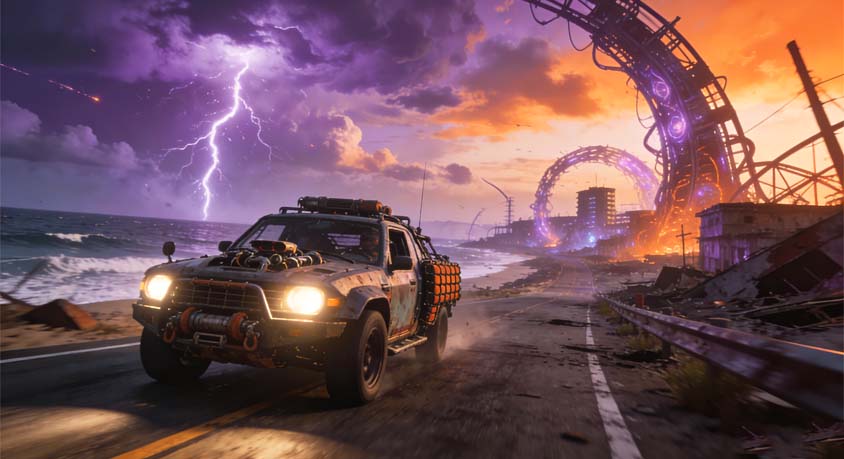
The premise is deceptively simple. You're in the Olympic Exclusion Zone, a swath of Pacific Northwest wilderness warped by reality-bending anomalies. Your only companion is a beat-up station wagon, a relic from a more normal time, that you find in a garage. Your mission: survive, explore, and eventually, escape. But the genius of Pacific Drive is that the car isn't just a vehicle; it's a character. You name it. You repair it. You upgrade it with scavenged parts, turning this rusty heap into a customized, slightly-less-rusty heap that you would absolutely die for. And you will die, repeatedly, because the zone does not want you there. It throws electrical storms, gravitational anomalies, and creatures that exist somewhere between science experiment and nightmare at you. And through it all, it's you and the station wagon. The radio crackles. The tires squeal. The engine, patched together with duct tape and hope, sputters but keeps going. It's The Road, but with better suspension.
This is where the game taps into something deeply American: the road trip as existential quest. We are a nation built on the idea of getting in the car and going somewhere else. The highway is our collective unconscious, the open road our national myth. Pacific Drive takes that myth and corrupts it, turning the open road into a trap, the journey into a survival struggle. Every trip into the zone is a gamble. You have a destination, a goal, but the route is unpredictable. Anomalies shift. Weather changes. Your car, that precious, fragile shell of metal and glass, takes damage. You find yourself making desperate calculations: do I push forward to that rare resource, or do I turn back while my tires still hold air? It's a road trip where the stakes aren't a better view—they're your digital life.
The roguelite structure reinforces this beautifully. Each run is a loop: prepare in your garage, venture out, survive (or not), return with loot, upgrade, repeat. The garage becomes a sanctuary, a place of safety and planning. You obsess over your car's loadout, its armor, its fuel efficiency, its ability to withstand the zone's specific horrors. You become, whether you intended to or not, a mechanic-shaman, performing rituals of maintenance and upgrade, praying to the gods of internal combustion that your next trip won't be your last. The game understands that survival isn't just about fighting; it's about preparation, about knowledge, about the quiet, desperate hope that your car will start one more time.
And yet, for all its terror and tension, Pacific Drive is weirdly, achingly beautiful. The Pacific Northwest landscape, rendered in moody, atmospheric detail, is a character itself. The fog rolling through ancient forests. The rain on your windshield. The eerie glow of anomalies in the distance. It's a world that feels alive, hostile, and hauntingly lovely. You'll find yourself stopping, sometimes, just to watch the light shift, knowing that beauty and danger are the same thing here.
So, why did this masterpiece get overlooked? Because it's hard to categorize. It's not a pure horror game. It's not a pure driving game. It's not a pure survival game. It's all of them, blended into something unique and slightly uncomfortable. It demands patience, attention, and a willingness to fail. In an era of instant gratification and algorithmic comfort food, Pacific Drive asks you to slow down, to care, to invest in a relationship with a digital car. And for those who did, it's unforgettable.
Disclaimer: Mention of any brand or trademark is for identification only and does not imply partnership or endorsement