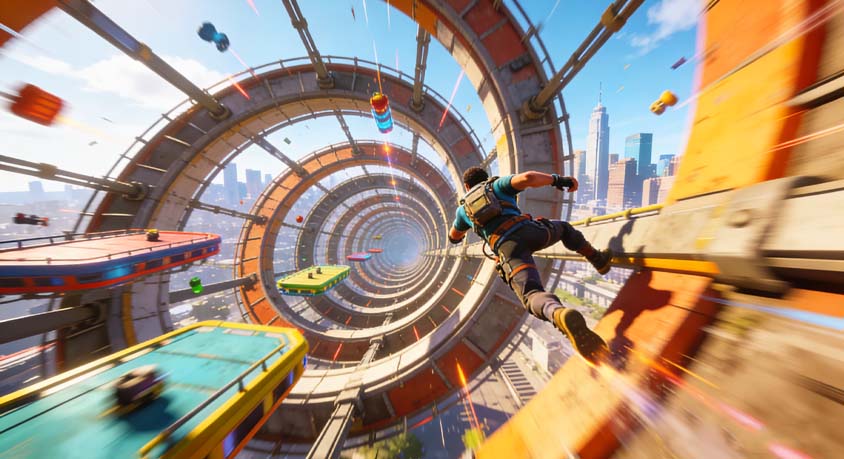
This game existed for exactly five months, three weeks, and a handful of days. It wasn't supposed to be important. It wasn't supposed to be a phenomenon. It was a solo project by a developer named SCKR Games, a simple premise wrapped in Unreal Engine assets: climb an endless, increasingly precarious tower made of floating junk, and try not to fall. The controls were janky. The physics were unpredictable. The camera had a mind of its own. By any traditional measure of game design, Only Up! was a mess. And for one glorious, chaotic summer, it was absolutely everywhere. Then, just as quickly as it appeared, it vanished. The developer pulled it from Steam, citing stress and legal threats. The game that streamers built was destroyed by the very attention that made it. This isn't just a story about a game. It's a parable about the strange, cruel economy of viral content, where success can be more dangerous than failure, and where the attention economy eats its own children.
To understand Only Up! , you have to understand the ecosystem that birthed it. This was not a game designed for quiet evenings on the couch. It was designed, consciously or not, for the chaotic theater of live streaming. The premise was perfect for content: every streamer played the same tower, but every journey was different. Falls were spectacular. Progress was fragile. The game was a machine for generating moments—the scream of triumph when you finally reached a new section, the wail of despair when a tiny misstep sent you tumbling back to the start after an hour of climbing. It was appointment viewing. Viewers watched not to see the game mastered, but to see their favorite personalities broken, rebuilt, and broken again. Only Up! wasn't a game; it was a reality show generator disguised as a platformer.
And for a few months, it worked beautifully. Streamers got content. Viewers got entertainment. The developer got sales. The game climbed the Steam charts, riding a wave of free marketing that most indie developers would kill for. But here's the thing about riding a wave: eventually, you have to come down. And the descent for Only Up! was brutal. The game wasn't designed for the scrutiny it received. Every bug, every glitch, every questionable asset choice was magnified by thousands of eyes. The developer, a solo creator suddenly thrust into the global spotlight, found himself managing not just a game, but a community, a brand, a legal department. When copyright claims surfaced over some of the game's assets, it was the final straw. The pressure cooker exploded. The game was pulled. The phenomenon was over.
This is the dark underbelly of the "streamer game" phenomenon. Viral success in the age of Twitch is not a stable state. It's a hurricane. You don't build a house in its path and expect it to survive. The games that thrive in this ecosystem—games like Among Us or Fall Guys—are often those with teams behind them, resources to handle the surge, communities to manage the chaos. For a solo developer, the sudden attention can be less an opportunity and more a slow-motion disaster. You're not just making a game anymore; you're running a business, managing PR crises, and dealing with legal threats, all while trying to fix bugs that are being broadcast to millions. It's a recipe for burnout, and Only Up! was the recipe perfected.
So, what's left now? A memory. A collection of clips. A cautionary tale told in developer discords and YouTube essays. Only Up! proved that a game doesn't need polish to succeed. It proved that the streaming ecosystem can mint hits from nothing. But it also proved that success, in this strange new world, can be a poison. The game that streamers built was destroyed by the very attention that made it, and in its absence, we're left with a question: how many other solo developers are watching this story and thinking, "Maybe I don't want that after all"? Because the dream of going viral is also, increasingly, the nightmare of being consumed.
Disclaimer: Mention of any brand or trademark is for identification only and does not imply partnership or endorsement