


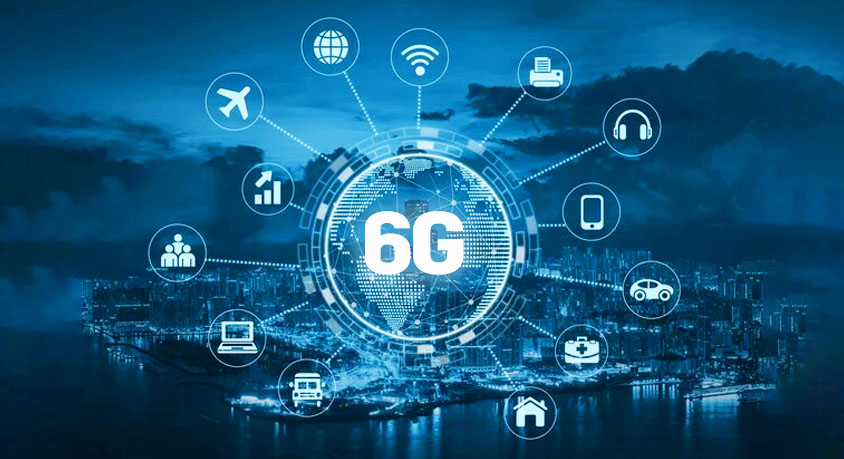
Your living room is empty. Then, with a faint shimmer of light, a three-dimensional figure materializes near your sofa—a colleague calling for a "face-to-face" meeting, rendered in perfect, life-sized holographic detail. This is the promised reality of 6G-enabled spatial computing and holographic IoT. The network's ultra-high bandwidth, near-zero latency, and integrated sensing capabilities allow for the real-time projection of high-fidelity holograms into your physical space. The convenience is revolutionary. The novel threat is equally profound: when your environment becomes a canvas for projected data, a malicious actor isn't just hacking your screen; they are hacking your perceived reality. A "virtual intruder" projected into your private space represents a new frontier of psychological attack and extortion, and the "off" button is not where you think.
The technical foundation makes this possible. Think of 6G not just as a faster internet, but as a unified field of communication and sensing. It uses frequencies in the terahertz spectrum and advanced beamforming to create precise "data pathways" through the air. Your holographic projector or AR glasses act as both a receiver and a spatial computer. They communicate with the network to precisely map your room in 3D (using integrated LiDAR or radar) and then calculate exactly where to render light particles to create a coherent, solid-looking image. The system relies on a continuous, trusted exchange of three things: authentication data (are you a valid user?), environmental mapping data (where are the walls and furniture?), and the holographic data stream itself. A breach in any of these three streams creates an attack vector.
The intrusion methods are multifaceted. First, device impersonation. A hacker could spoof the credentials of a trusted contact's holographic system, causing your device to accept and project their malicious avatar as if it were a legitimate call. Second, environmental data poisoning. By corrupting or intercepting the real-time mapping data your system uses to place holograms, an attacker could make a threatening figure appear to be standing right in front of you, rather than safely confined to a "projection zone." Third, direct stream hijacking. By man-in-the-middle attacking the holographic data stream, they could replace a benign image with a threatening one mid-call. The goal is not to steal data, but to implant a traumatic, coercive experience directly into your personal sanctuary. The demand to "pay now or I won't disappear" takes on a literal, terrifying meaning.
This creates a unique defensive challenge. You cannot simply unplug a hologram the way you can throw out a tainted piece of mail. The offensive action is happening in the combination of your own hardware and the network. Therefore, your security protocol must be physical, digital, and procedural. First, institute a mandatory physical cutoff. Any holographic projection system must be connected to its power source and network via a smart plug with a prominent, hardware-based kill switch—a literal big red button on your wall. When pressed, it must cut all power and data to the projector/glasses instantly, no software confirmation needed. This is your emergency stop for reality. Second, compartmentalize your spatial data. Configure your system so that the detailed 3D map of your home is stored only locally on a dedicated chip, never transmitted to the cloud or shared during a call. The network should receive only a generic "allow projection" or "block projection" signal for specific zones, not a blueprint of your furniture. Third, establish verification rituals. For unexpected or sensitive holographic connections, use a separate, out-of-band verification step. A quick text or pre-shared code via a different device confirming the call is legitimate before accepting the holographic session.
The era of immersive connectivity demands a new security philosophy: you must defend your spatial integrity as rigorously as your network perimeter. Your home is no longer just a physical space; it is a rendered environment. Treat your holographic projector as a potential portal, not just a device. Your goal is to maintain absolute control over what gets to paint light in your air. The 6G future requires that your most intuitive defense—reaching out to swat a hologram away—is backed by a layered system of hard switches, data isolation, and verification habits. Trust in the immersive experience, but verify every connection, and keep the power to vanish the entire canvas at your fingertips. The ultimate privacy setting in 2026 is the ability to instantly return your living room to a state of ordinary, unprojected air.
Disclaimer: Mention of any brand or trademark is for identification only and does not imply partnership or endorsement